I spent two days in this quiet corner of Rheinland-Pfalz, driving on everything from forest trails to motorways, with family and gear loaded up. Below is a deep dive into how the Kangoo performed, not as a spec sheet, but as a real-world companion on the road.
Renault Kangoo: More Comfortable Inside Than Before
Stepping inside the new Renault Kangoo was my first real surprise. Gone are the utilitarian, plastic-heavy days of the earlier Kangoos. Renault has embraced refinement, not luxury, but practical comfort. My test car was the Techno trim, and immediately I noticed the clean layout, the floating eight-inch touchscreen, and details like aluminum accents on the dash. It was no Audi, but it felt far from a van.
Driving through the sleepy town of Annweiler am Trifels, my partner appreciated the height-adjustable lumbar support in the front passenger seat. The front seats were firm but welcoming, we drove for hours without complaint, a rare feat in high-roof wagons. Visibility was fantastic thanks to the upright driving position and large windows, perfect for watching the forest zip by.
Storage was everywhere: trays, deep pockets, a slide-out glovebox, and a nifty wireless phone charging tray. Even the kids in the back commented on how “it’s like a spaceship”, high praise from 8- and 11-year-olds.
Renault Kangoo with Huge Trunk
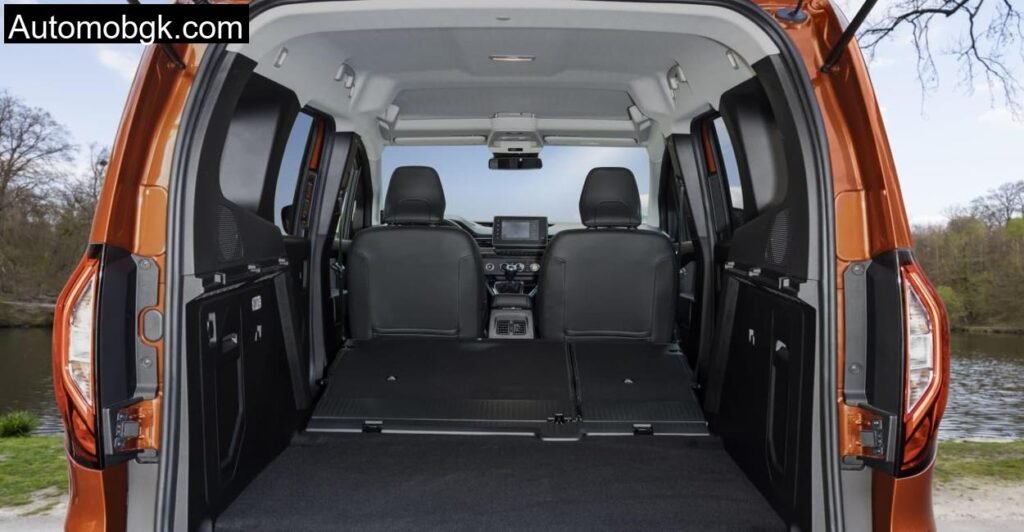
One reason families gravitate toward the Kangoo is space, and it delivers. Behind the rear bench, the standard Kangoo swallowed our picnic baskets, hiking boots, and camera gear with room to spare. The 530-liter boot expands to a cavernous 2125 liters once the rear seats are folded flat.
On the second day, I folded the front passenger seat flat to transport a nearly 2.5-meter-long canvas I picked up from a local art shop in Neustadt. No van needed. The optional fold-flat front seat (€250) suddenly seemed like a must-have.
Renault’s roof rails are clever too, hidden crossbars fold out when needed, so we mounted our bikes without needing to lug around extra accessories. Even tall people (like my 1.93-meter frame) can move about the cargo area without bending over. You begin to realize this isn’t a “big small car”, it’s a lifestyle tool.
Renault Grand Kangoo: Seven People on the Road
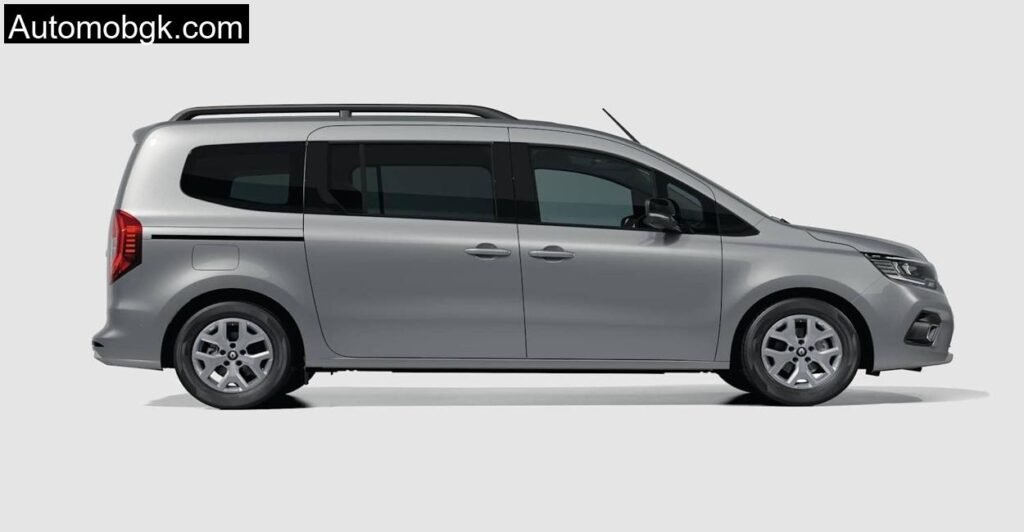
I switched to the Grand Kangoo on day two to ferry a full crew of six for a forest lodge outing. At 4.91 meters long, it’s about 38 centimeters longer than the regular model. You feel the difference instantly, mostly in the rear.
In the third row, I sat comfortably, and I’m not small. With the second-row seats slid forward just slightly, there was still legroom. Everyone had their own space, and the roofline never intruded. The seating layout was modular and smart: all rear seats could slide, fold, or be completely removed. The downside? You’ll have to unplug the seat occupancy sensors, which can be fiddly.
Even with all seven seats up, we still had 430 liters of boot space. For comparison, that’s more than many compact crossovers. Folding the third row gave us over 1100 liters. We packed a barbecue set, sports bags, and several backpacks without playing luggage Tetris.
The Kangoo TCe 130 in the Test
Under the hood, the TCe 130 is a 1.3-liter four-cylinder turbo petrol engine producing 130 hp and 240 Nm of torque. Sounds modest on paper, but in practice, it’s remarkably responsive. Whether I was overtaking on the Autobahn or climbing the forest roads to Burg Trifels, the engine never felt strained.
It comes alive at just 1500 rpm and pulls cleanly through the gears. I had the six-speed manual, the throws were light and well-defined. If you prefer auto, a seven-speed dual-clutch option is available, but I enjoyed the control offered by the stick.
Flexibility is the name of the game here. In fourth, fifth, and sixth gears, the Kangoo remained eager. No lag, no frustrating flat spots. And while this is no sports car, it moves with confidence, especially when unladen.
7.2 and 7.5 Liters Consumption in the Test
Fuel economy wasn’t extraordinary but felt acceptable given the car’s purpose. I averaged 7.3 liters per 100 km in mixed driving, close to the 7.2-liter result for the standard Kangoo and 7.5 for the Grand Kangoo.
Keep it under 120 km/h and cruise gently through towns like Dahn and Hauenstein, and you’ll see low 7s. Push it up twisty inclines, as I did near Johanniskreuz, and you’ll hit 8+ liters. This isn’t a hybrid, so expectations must be managed.
Still, for the size, the efficiency is decent, especially considering its ability to haul seven people and still feel composed.
Kangoo Rapid with Wide Loading Opening
Though I didn’t test the Rapid van version, I stopped by a Renault dealer in Pirmasens that had one on display. The standout? The innovative wide opening without a central B-pillar on the right-hand side (not available on the passenger version). It looked ideal for tradespeople and couriers.
The double sliding doors opened with one hand and revealed an unbroken load floor, a feature that earned a knowing nod from a local delivery driver who stopped by. Renault clearly kept its commercial roots intact while upgrading the people-mover version.
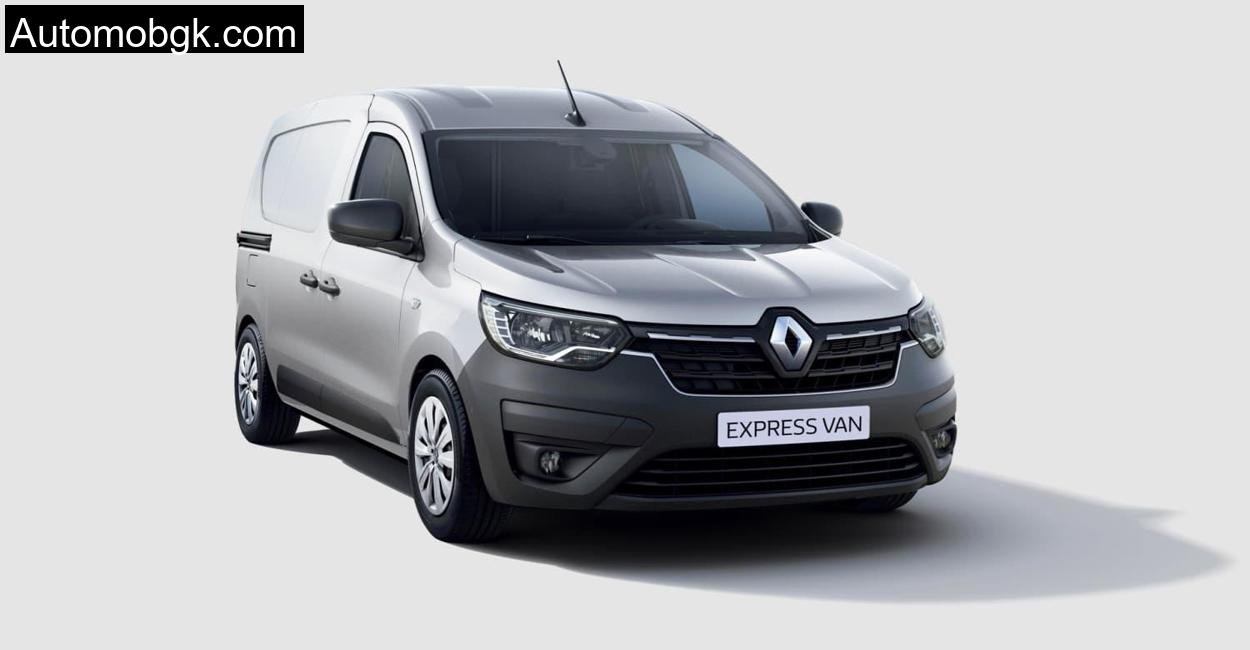
The Express as Dokker Successor
While not directly part of my test, the Express, the entry-level variant of the Kangoo lineup and successor to the Dacia Dokker, deserves mention. It’s stripped down, cheaper, and lacks some of the Kangoo’s polish, but it still carries the same design DNA. Aimed squarely at budget-conscious users, it fills the space the Dokker once held.
Technical Specification
| Category | Specification |
| Engine Type | 1.3L TCe 130, 4-cylinder turbocharged petrol |
| Displacement | 1,333 cc |
| Max Power | 130 hp (96 kW) @ 5,000 rpm |
| Max Torque | 240 Nm @ 1,600 rpm |
| Transmission | 6-speed manual or 7-speed EDC automatic |
| Drivetrain | Front-wheel drive (FWD) |
| Fuel Type | Petrol (Euro 6D-Final compliant) |
| Fuel Tank Capacity | 54 liters |
| Top Speed | ~183 km/h (electronically limited) |
| 0–100 km/h Acceleration | ~11.6 seconds |
🚗 Dimensions & Capacities
| Category | Specification |
| Overall Length | 4,486 mm |
| Overall Width | 1,859 mm (without mirrors) |
| Overall Height | 1,839 mm |
| Wheelbase | 2,716 mm |
| Ground Clearance | Approx. 165 mm |
| Boot Space | 775 liters (rear seats up) |
| Maximum Load Volume | Up to 3,500 liters (with seats folded) |
| Kerb Weight | ~1,500–1,550 kg (varies slightly by trim) |
| Maximum Towing Capacity | 1,500 kg (braked) |
⚙️ Chassis & Suspension
| Category | Specification |
| Front Suspension | MacPherson struts |
| Rear Suspension | Torsion beam with coil springs |
| Brakes (Front/Rear) | Ventilated discs / Solid discs |
| Steering Type | Electric power-assisted rack and pinion |
| Turning Circle | Approx. 11.2 meters |
| Tyres | 195/65 R16 or 205/60 R16 (varies by trim) |
💡 Technology & Features
| Category | Specification |
| Infotainment Display | 8-inch touchscreen with Easy Link system |
| Connectivity | Apple CarPlay, Android Auto, Bluetooth |
| USB Ports | 2 x USB-A, 1 x USB-C (depending on trim) |
| Climate Control | Manual or automatic (dual-zone optional) |
| Instrument Cluster | Analog with digital TFT center display |
Conclusion
After two days of real-world use,packing, hauling, exploring, and simply living with the Kangoo, I came away with a new respect for it. No, it’s not the most exciting car. It doesn’t thrill or whisper luxury. But it is honest. It delivers on every promise it makes: comfort, space, and usability, all wrapped in a cleaner, smarter design than ever before.
Whether you’re a family needing room for kids and cargo, or a road-tripper with a love for long weekends and practical gear, the Kangoo feels like a tool that understands you. It’s a van that’s grown up, and grown comfortable doing it.
Is the Renault Kangoo TCe 130 suitable for long road trips?
Yes, especially the Grand Kangoo variant. With comfortable seating, good visibility, and enough power for highways, it makes an ideal travel companion for families.
Can adults sit in the third row of the Grand Kangoo?
Absolutely. Even tall adults can sit comfortably in the third row, making it one of the few true 7-seaters in its segment.
What’s the biggest highlight of the new Kangoo?
Its versatility. From modular seats to clever storage and loading options, it adapts to nearly any lifestyle, without sacrificing comfort.